GeForce RTX 3050 & Radeon RX 580 share many similarities, but there are also important differences, such as quality, performance, features, design, and connectivity. If you want the best one between them, I Would recommend the GeForce RTX 3050 rather than the Radeon RX 580.
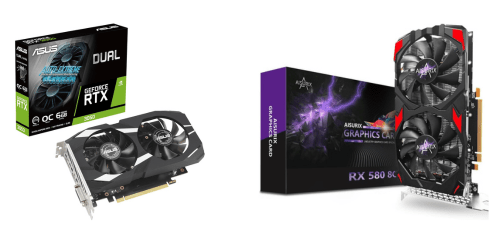
Why Do I Recommend The GeForce RTX 3050?
- The GeForce RTX 3050 features hardware ray tracing cores for realistic lighting, shadows, and reflections in supported games, while the Radeon RX 580 has no dedicated ray tracing hardware.
- GeForce RTX 3050 supports DLSS for higher frame rates and improved image clarity at 1080p and 1440p resolutions, whereas the Radeon RX 580 uses traditional spatial upscaling.
- It comes with a newer Ampere architecture for better performance per watt and lower power consumption during gaming, while the Radeon RX 580 uses the older Polaris architecture.
- The GeForce RTX 3050 includes Tensor cores for accelerating AI-driven features and upscaling tasks, whereas the Radeon RX 580 has no AI acceleration hardware.
- GeForce RTX 3050 supports DirectX 12 Ultimate for access to modern graphics features used by newer game engines, while the Radeon RX 580 supports standard DirectX 12.
- It comes with GDDR6 memory for higher memory efficiency and faster data transfer in modern games, whereas the Radeon RX 580 uses GDDR5 memory.
- The GeForce RTX 3050 supports HDMI 2.1 for higher refresh rates and better compatibility with newer monitors and TVs, while the Radeon RX 580 supports HDMI 2.0.
- GeForce RTX 3050 includes a newer NVENC video encoder for smoother streaming and faster video encoding with lower CPU usage, while the Radeon RX 580 uses an older VCE encoder.
Maybe the Radeon RX 580 can make you comfortable because it’s a little bit cheaper than the GeForce RTX 3050. But you have to compromise all the above-mentioned features. Now the Decision is Yours. I hope it was helpful to choose the right one.
Side-by-Side Comparison
| Feature | GeForce RTX 3050 | Radeon RX 580 |
| GPU Architecture | Ampere | Polaris |
| Process Node | 8 nm | 14 nm |
| Ray Tracing Hardware | Yes | No |
| AI / Tensor Cores | Present | Absent |
| Upscaling Technology | DLSS | None |
| Shader Count | 2560 CUDA cores | 2304 Stream processors |
| Base Clock | ~1550 MHz | ~1257 MHz |
| Boost Clock | ~1777 MHz | ~1340 MHz |
| Memory Type | GDDR6 | GDDR5 |
| Memory Speed | 14 Gbps | 8 Gbps |
| Power Efficiency | Higher | Lower |
| AV1 Decode | Supported | Not supported |
| Video Encoder | NVENC | VCE |
| DirectX Feature Level | DirectX 12 Ultimate | DirectX 12 |
| Vulkan Version | 1.3 | 1.1 |
| HDMI Standard | HDMI 2.1 | HDMI 2.0 |
| Driver Focus | Modern titles | Legacy titles |
| Price | Check GeForce RTX 3050 Price | Check Radeon RX 580 Price |
What Common Both Can Do?
- Desktop GPU: Both graphics cards are designed for desktop systems and require installation into a standard PC motherboard, making them unsuitable for mobile or laptop-only environments.
- Discrete Graphics Card: Each model is a standalone GPU with its own dedicated memory, allowing them to operate independently from the CPU’s integrated graphics.
- Gaming-Oriented GPU: Both the GeForce RTX 3050 and the Radeon RX 580 are built to handle modern PC games, supporting common gaming resolutions and graphical workloads.
- PCI Express Interface: Each card connects to the system through a PCI Express slot, ensuring compatibility with mainstream consumer motherboards.
- Dedicated VRAM: Both GPUs include their own video memory, which helps maintain consistent performance in games and graphics-heavy applications.
- 8 GB VRAM Variants: Each graphics card is available in configurations with 8 GB of VRAM, allowing them to manage higher texture resolutions more effectively.
- Multi-Monitor Support: Both models can drive multiple displays at the same time, making them suitable for productivity setups and expanded gaming displays.
- HDMI Output: Each card includes HDMI connectivity, allowing direct connection to modern TVs and monitors without adapters.
- DisplayPort Output: Both GPUs support DisplayPort connections, enabling higher refresh rates and resolutions on compatible monitors.
- DirectX 12 Support: Both graphics cards are compatible with DirectX 12, allowing them to run modern games that rely on this graphics API.
- Vulkan API Support: Each GPU supports the Vulkan API, which provides low-level access to the hardware and improves efficiency in supported games and applications.
- OpenGL Support: Both cards maintain OpenGL compatibility, ensuring support for older games, professional software, and cross-platform applications.
- Hardware Video Decoding: Each GPU includes dedicated hardware for video decoding, reducing CPU usage during video playback and streaming.
- External Power Connector Required: Both graphics cards require additional power from the power supply via dedicated connectors, rather than relying solely on motherboard power.
- Active Cooling Required: Each GPU depends on active cooling solutions such as fans or heatsinks to maintain stable operating temperatures under load.
- Third-Party AIB Models: Both GPUs are available from multiple board partners, resulting in variations in cooling designs, clock speeds, and form factors.
- Windows OS Support: Each graphics card is fully supported on modern Windows operating systems, allowing access to drivers, updates, and gaming platforms.
Common Features
| Feature | GeForce RTX 3050 | Radeon RX 580 |
| Desktop GPU | Yes | Yes |
| Discrete Graphics Card | Yes | Yes |
| Gaming-Oriented GPU | Yes | Yes |
| PCI Express Interface | Yes | Yes |
| Dedicated VRAM | Yes | Yes |
| 8 GB VRAM Variants | Yes | Yes |
| Multi-Monitor Support | Yes | Yes |
| HDMI Output | Yes | Yes |
| DisplayPort Output | Yes | Yes |
| DirectX 12 Support | Yes | Yes |
| Vulkan API Support | Yes | Yes |
| OpenGL Support | Yes | Yes |
| Hardware Video Decoding | Yes | Yes |
| External Power Connector Required | Yes | Yes |
| Active Cooling Required | Yes | Yes |
| Third-Party AIB Models | Yes | Yes |
| Windows OS Support | Yes | Yes |
| Price | Check GeForce RTX 3050 Price | Check Radeon RX 580 Price |
FAQ
Is GeForce RTX 3050 newer than Radeon RX 580? Do both graphics cards support modern PC games? Is 8 GB of VRAM available on both GPUs? Can both GPUs be used for 1080p gaming? Do both cards support DirectX 12? Is ray tracing available on both GPUs? Are both GPUs compatible with PCIe motherboards? Do both graphics cards require external power connectors? Can both GPUs support multiple monitors? Are HDMI and DisplayPort supported on both cards? Do both GPUs support Vulkan API? Is hardware video decoding available on both GPUs? Are both GPUs actively cooled? Can both GPUs be used for casual content creation? Are both GPUs suitable for budget gaming builds? |