GeForce RTX 2070 & Radeon RX 5700 XT share many similarities, but there are also important differences, such as quality, performance, features, design, and connectivity. If you want the best one between them, I Would recommend the GeForce RTX 2070 rather than the Radeon RX 5700 XT.
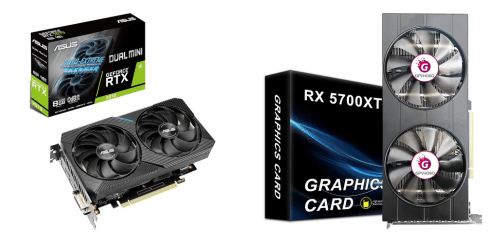
Why Do I Recommend The GeForce RTX 2070?
- The GeForce RTX 2070 features dedicated RT cores for real-time ray tracing effects with accurate lighting, reflections, and shadows in supported games, while the Radeon 5700 XT uses standard shaders without hardware ray tracing acceleration.
- GeForce RTX 2070 includes Tensor cores to enable DLSS upscaling for higher frame rates and improved image clarity at higher resolutions, whereas the Radeon 5700 XT relies on native resolution rendering without AI-based upscaling.
- It comes with the NVENC hardware encoder for higher-quality game streaming and recording with minimal CPU usage, while the Radeon 5700 XT uses the VCE encoder with lower efficiency and quality consistency.
- The GeForce RTX 2070 supports NVIDIA Reflex to reduce system latency for faster input response in competitive games, whereas the Radeon 5700 XT uses Radeon Anti-Lag with more limited latency optimization scope.
- GeForce RTX 2070 has lower typical board power consumption to maintain cooler operation and quieter cooling under sustained gaming loads, while the Radeon 5700 XT uses higher power levels that increase heat output.
- It supports the CUDA platform for broader acceleration in professional applications like video editing, rendering, and AI workloads, while the Radeon 5700 XT uses OpenCL with narrower software support.
- The GeForce RTX 2070 includes stronger VRWorks support for smoother frame pacing and better compatibility with VR titles, whereas the Radeon 5700 XT relies on standard VR pipelines without dedicated optimizations.
- GeForce RTX 2070 features more mature driver optimization for ray-traced and feature-rich PC games at launch settings, while the Radeon 5700 XT focuses primarily on rasterized performance without advanced rendering features.
Maybe the Radeon RX 5700 XT can make you comfortable because it’s a little bit cheaper than the GeForce RTX 2070. But you have to compromise all the above-mentioned features. Now the Decision is Yours. I hope it was helpful to choose the right one.
Side-by-Side Comparison
| Feature | GeForce RTX 2070 | Radeon RX 5700 XT |
| GPU Architecture | Turing | RDNA 1.0 |
| Manufacturing Process | 12nm | 7nm |
| Compute Units / SMs | 36 SMs | 40 CUs |
| Ray Tracing Hardware | RT cores | None |
| AI Acceleration | Tensor cores | None |
| Video Encoder | NVENC | VCE |
| Video Decoder | NVDEC | UVD |
| Upscaling Support | DLSS | None |
| Latency Reduction | NVIDIA Reflex | Radeon Anti-Lag |
| Linux Driver Stack | Proprietary | Open-source |
| Price | Check GeForce RTX 2070 Price | Check Radeon RX 5700 XT Price |
What Common Both Can Do?
- Discrete Graphics Card: Both GPUs are standalone graphics cards designed to operate independently from integrated graphics solutions. This allows them to deliver significantly higher performance for gaming, rendering, and GPU-accelerated workloads.
- Desktop GPU: Each model is designed specifically for desktop PC systems rather than laptops or mobile devices. This ensures higher power limits, better cooling options, and stronger sustained performance.
- Gaming Focused: Both GPUs are built primarily for gaming workloads, targeting high settings at 1080p and 1440p resolutions. Their architectures are optimized for modern game engines and real-time rendering.
- PCIe x16 Interface: Both cards use a PCIe x16 physical interface for connection to the motherboard. This provides ample bandwidth for data transfer between the GPU and the CPU.
- GDDR6 Memory: Each GPU uses GDDR6 memory technology, which delivers high bandwidth and improved efficiency over older GDDR5 memory. This helps maintain smooth performance in memory-intensive games.
- 8 GB VRAM: Both models are equipped with 8 GB of video memory, which is sufficient for modern games, high-resolution textures, and demanding graphical workloads at common resolutions.
- 256-bit Memory Bus: The two GPUs use a 256-bit memory bus, enabling wide data paths between the GPU and memory. This supports consistent performance when handling large texture data.
- 14 Gbps Memory Speed: Both graphics cards operate their memory at 14 Gbps, ensuring comparable raw memory throughput. This helps minimize memory bottlenecks during gaming and rendering tasks.
- DirectX 12 Support: Each GPU fully supports DirectX 12, allowing access to modern graphics features and improved CPU-to-GPU workload management in newer games.
- Vulkan Support: Both cards support the Vulkan API, enabling efficient low-level graphics access. This benefits games and applications optimized for reduced overhead and better scaling.
- OpenGL Support: Each GPU supports OpenGL, ensuring compatibility with a wide range of professional applications, older games, and visualization software.
- Multi-Monitor Support: Both GPUs can drive multiple displays simultaneously, making them suitable for productivity setups, streaming workflows, and immersive gaming environments.
- HDMI Output: Each model includes HDMI output support, allowing easy connection to TVs, monitors, and capture devices without adapters.
- DisplayPort Output: Both GPUs support DisplayPort connections, which are commonly used for high-refresh-rate and high-resolution monitors.
- VR Ready: Each GPU meets the performance requirements for virtual reality applications. This allows smooth operation with mainstream VR headsets when paired with a capable system.
- Hardware Video Decoding: Both cards include dedicated hardware for video decoding, reducing CPU load during video playback and improving power efficiency.
- Hardware Video Encoding: Each GPU features built-in video encoding hardware, enabling efficient game recording, streaming, and video export tasks.
- FreeSync Compatibility: Both GPUs support FreeSync technology, allowing compatible monitors to synchronize refresh rates with frame output for smoother, tear-free gameplay.
Common Features
| Feature | GeForce RTX 2070 | Radeon RX 5700 XT |
| Discrete Graphics Card | Yes | Yes |
| Desktop GPU | Yes | Yes |
| Gaming Focused | Yes | Yes |
| PCIe x16 Interface | Yes | Yes |
| GDDR6 Memory | Yes | Yes |
| 8 GB VRAM | Yes | Yes |
| 256-bit Memory Bus | Yes | Yes |
| 14 Gbps Memory Speed | Yes | Yes |
| DirectX 12 Support | Yes | Yes |
| Vulkan Support | Yes | Yes |
| OpenGL Support | Yes | Yes |
| Multi-Monitor Support | Yes | Yes |
| HDMI Output | Yes | Yes |
| DisplayPort Output | Yes | Yes |
| VR Ready | Yes | Yes |
| Hardware Video Decoding | Yes | Yes |
| Hardware Video Encoding | Yes | Yes |
| FreeSync Compatibility | Yes | Yes |
| Price | Check GeForce RTX 2070 Price | Check Radeon RX 5700 XT Price |
FAQ
Is the GeForce RTX 2070 still good for modern gaming? Is the Radeon RX 5700 XT faster than the GeForce RTX 2070 in games? Do both GPUs support ray tracing? Which card is better for streaming and recording gameplay? Are both GPUs suitable for 1440p gaming? Do both graphics cards have the same amount of VRAM? Which GPU consumes more power? Is PCIe 4.0 support important between these two GPUs? Which GPU is better for ray-traced games? Do both cards support FreeSync monitors? Are these GPUs good for virtual reality? Which card runs cooler on average? Is driver support stable for both GPUs today? Which GPU is better for content creation workloads? Are these GPUs still worth buying used? |