Radeon RX 5700 & GeForce RTX 2060 share many similarities, but there are also important differences, such as quality, performance, features, design, and connectivity. If you want the best one between them, I Would recommend the Radeon RX 5700 rather than the GeForce RTX 2060.
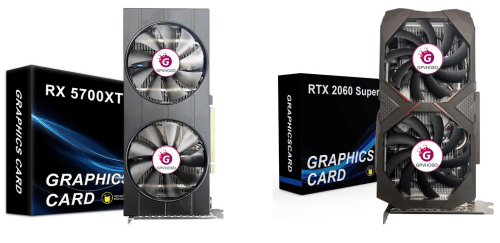
Why Do I Recommend The Radeon RX 5700?
- The Radeon RX 5700 features a wider 256-bit memory bus for higher data throughput and more consistent performance at high resolutions, while the GeForce RTX 2060 uses a narrower 192-bit memory bus.
- Radeon RX 5700 comes with 8 GB GDDR6 VRAM to handle larger textures and reduce memory bottlenecks in modern games, whereas the GeForce RTX 2060 comes with 6 GB GDDR6 VRAM.
- It includes higher memory bandwidth for faster texture streaming and smoother gameplay at 1440p, while the GeForce RTX 2060 has lower overall memory bandwidth.
- The Radeon RX 5700 features a 7 nm manufacturing process to deliver higher transistor density and stronger raw raster performance, while the GeForce RTX 2060 uses a 12 nm process.
- Radeon RX 5700 includes more stream processors to improve parallel shader workloads and boost frame rates in non-ray-traced games, whereas the GeForce RTX 2060 uses fewer CUDA cores.
- It features higher rasterization throughput for better performance in traditional AAA titles, while the GeForce RTX 2060 prioritizes dedicated hardware for ray tracing.
- The Radeon RX 5700 supports PCIe 4.0 for increased bandwidth headroom on modern platforms and improved future scalability, while the GeForce RTX 2060 supports PCIe 3.0.
- Radeon RX 5700 features stronger raw compute performance to maintain higher average FPS in standard rendering pipelines, whereas the GeForce RTX 2060 devotes part of its silicon to AI and ray-tracing cores rather than raster performance.
Maybe the GeForce RTX 2060 can make you comfortable because it’s a little bit cheaper than the Radeon RX 5700. But you have to compromise all the above-mentioned features. Now the Decision is Yours. I hope it was helpful to choose the right one.
Side-by-Side Comparison
| Feature | Radeon RX 5700 | GeForce RTX 2060 |
| GPU Architecture | RDNA 1.0 | Turing |
| Manufacturing Node | 7 nm | 12 nm |
| Shader Type | Stream processors | CUDA cores |
| Shader Count | 2304 | 1920 |
| Compute Units / SMs | 36 CUs | 30 SMs |
| Texture Units | 144 | 120 |
| ROP Units | 64 | 48 |
| Base Clock | ~1465 MHz | ~1365 MHz |
| Boost / Game Clock | ~1725 MHz | ~1680 MHz |
| Memory Capacity | 8 GB | 6 GB |
| Memory Bus Width | 256-bit | 192-bit |
| Memory Bandwidth | ~448 GB/s | ~336 GB/s |
| PCI Express Version | PCIe 4.0 | PCIe 3.0 |
| Encoder Type | VCE | Turing NVENC |
| Total Board Power | ~180 W | ~160 W |
| Recommended PSU | 600 W | 500 W |
| VR Feature Stack | Standard VR | VRWorks |
| Price | Check Radeon RX 5700 Price | Check GeForce RTX 2060 Price |
What Common Both Can Do?
- Desktop GPU Class: Both graphics cards are designed for desktop systems, making them suitable for standard ATX and mATX gaming PC builds. This ensures broad compatibility with mainstream motherboards and power supplies.
- Gaming-Focused GPU: Each model is primarily targeted at gamers, emphasizing strong real-time rendering performance for modern PC titles. This focus ensures stable frame rates and optimized driver support for games.
- Discrete Graphics Card: Both are standalone GPUs that do not rely on integrated graphics, providing dedicated video memory and processing resources. This allows for significantly higher performance compared to integrated solutions.
- GDDR6 Memory Type: Each card uses GDDR6 memory, which provides higher data transfer speeds than older GDDR5 memory. This helps improve texture loading and overall rendering responsiveness in games.
- DirectX 12 Support: Both GPUs fully support DirectX 12, enabling modern rendering techniques used in current and upcoming games. This support ensures compatibility with advanced lighting, shading, and compute features.
- Vulkan API Support: Each card supports the Vulkan graphics API, which allows developers to achieve lower-level hardware access and improved performance efficiency. This is especially important for cross-platform and performance-optimized games.
- OpenGL Support: Both GPUs maintain support for OpenGL, ensuring compatibility with older games and professional applications. This allows users to run legacy software without issues.
- PCIe x16 Slot: Each graphics card installs into a standard PCIe x16 slot, making them easy to integrate into most desktop motherboards. This ensures straightforward upgrades without special hardware requirements.
- HDMI Output Support: Both models include HDMI output support, allowing connection to TVs and monitors using a common display standard. This is useful for gaming, media playback, and living-room PC setups.
- DisplayPort Support: Each GPU supports DisplayPort connections, which are commonly used for high-refresh-rate and high-resolution monitors. This enables smoother gameplay and better display flexibility.
- Multi-Monitor Support: Both cards can drive multiple displays simultaneously, supporting productivity setups and immersive gaming environments. This is useful for streamers, multitaskers, and simulation gamers.
- VR Ready Certification: Each GPU meets baseline VR performance requirements, enabling compatibility with popular virtual reality headsets. This ensures smoother VR experiences with reduced latency and motion issues.
- Hardware Video Decode: Both GPUs include hardware-accelerated video decoding, reducing CPU usage during video playback. This results in smoother streaming and better efficiency when watching high-resolution content.
- Variable Refresh Rate: Each card supports variable refresh rate technologies, helping eliminate screen tearing and reduce stutter. This improves visual smoothness during fast-paced gaming.
- Driver Software Suite: Both AMD and NVIDIA provide dedicated driver software with performance optimizations and feature updates. This ensures ongoing compatibility and performance improvements over time.
- Single-GPU Design: Each model is built as a single-GPU solution rather than a multi-GPU configuration. This simplifies system setup and avoids compatibility issues associated with multi-GPU scaling.
Common Features
| Feature | Radeon RX 5700 | GeForce RTX 2060 |
| Desktop GPU Class | Yes | Yes |
| Gaming-Focused GPU | Yes | Yes |
| Discrete Graphics Card | Yes | Yes |
| GDDR6 Memory Type | Yes | Yes |
| DirectX 12 Support | Yes | Yes |
| Vulkan API Support | Yes | Yes |
| OpenGL Support | Yes | Yes |
| PCIe x16 Slot | Yes | Yes |
| HDMI Output Support | Yes | Yes |
| DisplayPort Support | Yes | Yes |
| Multi-Monitor Support | Yes | Yes |
| VR Ready Certification | Yes | Yes |
| Hardware Video Decode | Yes | Yes |
| Variable Refresh Rate | Yes | Yes |
| Driver Software Suite | Yes | Yes |
| Single-GPU Design | Yes | Yes |
| Price | Check Radeon RX 5700 Price | Check GeForce RTX 2060 Price |
FAQ
Is the Radeon RX 5700 more powerful than the GeForce RTX 2060? Does the GeForce RTX 2060 support ray tracing while the RX 5700 does not? Which GPU is better for DLSS and AI-based features? Is the Radeon RX 5700 better for 1440p gaming? Which graphics card is more power efficient? Do both GPUs support modern graphics APIs? Is video encoding better on the RTX 2060? Are both cards suitable for VR gaming? Which GPU has more video memory? Does PCIe version matter between these two GPUs? Which card is better for older or non-ray-traced games? Is the RTX 2060 better for creators and streamers? Do both GPUs support multiple monitors? Which GPU has better long-term driver optimization? Is either GPU suitable for modern AAA gaming today? |