GeForce RTX 2070 & GeForce RTX 2060 share many similarities, but there are also important differences, such as quality, performance, features, design, and connectivity. If you want the best one between them, I Would recommend the GeForce RTX 2070 rather than the GeForce RTX 2060.
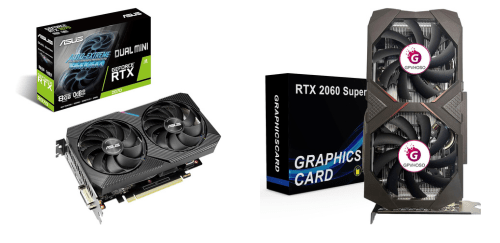
Why Do I Recommend The GeForce RTX 2070?
- The GeForce RTX 2070 has 2304 CUDA cores for higher parallel processing performance in modern games and GPU-accelerated workloads, while the GeForce RTX 2060 has 1920 CUDA cores.
- GeForce RTX 2070 features 8 GB GDDR6 memory to handle higher-resolution textures and reduce VRAM limitations in newer titles, whereas the GeForce RTX 2060 comes with 6 GB GDDR6 memory.
- It includes a 256-bit memory bus for higher memory throughput and smoother performance at 1440p and above, while the GeForce RTX 2060 uses a narrower 192-bit memory bus.
- The GeForce RTX 2070 supports 448 GB per second memory bandwidth to minimize bottlenecks in texture-heavy and ray-traced workloads, whereas the GeForce RTX 2060 supports 336 GB per second memory bandwidth.
- GeForce RTX 2070 comes with more RT cores for improved real-time ray tracing performance and more stable frame rates with lighting effects, while the GeForce RTX 2060 includes fewer RT cores.
- It features more Tensor cores for faster DLSS processing and better image reconstruction at higher resolutions, whereas the GeForce RTX 2060 features fewer Tensor cores.
- The GeForce RTX 2070 supports NVLink for multi-GPU configurations in supported professional and compute workloads, while the GeForce RTX 2060 does not support NVLink.
- GeForce RTX 2070 has a higher power and thermal headroom to sustain stronger boost clocks under extended gaming or rendering sessions, while the GeForce RTX 2060 operates with lower power limits.
Maybe the GeForce RTX 2060 can make you comfortable because it’s a little bit cheaper than the GeForce RTX 2070. But you have to compromise all the above-mentioned features. Now the Decision is Yours. I hope it was helpful to choose the right one.
Side-by-Side Comparison
| Feature | GeForce RTX 2070 | GeForce RTX 2060 |
| CUDA Cores | 2304 | 1920 |
| SM Units | 36 | 30 |
| Tensor Cores | 288 | 240 |
| RT Cores | 36 | 30 |
| Base Clock | 1410 MHz | 1365 MHz |
| Memory Capacity | 8 GB GDDR6 | 6 GB GDDR6 |
| Memory Bus Width | 256-bit | 192-bit |
| Memory Bandwidth | 448 GB/s | 336 GB/s |
| L2 Cache | 4 MB | 3 MB |
| ROPs | 64 | 48 |
| Texture Units | 144 | 120 |
| NVLink Support | Yes | No |
| TDP | 175 W | 160 W |
| Recommended PSU | 550 W | 500 W |
| Die Utilization | Higher | Lower |
| Board Power Limit | Higher | Lower |
| Price | Check GeForce RTX 2070 Price | Check GeForce RTX 2060 Price |
What Common Both Can Do?
- GPU Architecture: Both graphics cards are based on NVIDIA’s Turing architecture, which introduced major advancements in real-time ray tracing and AI-accelerated rendering. This shared architecture ensures similar feature compatibility across modern games and creative applications.
- Manufacturing Process: Each GPU is built on a 12 nm process, balancing performance and power efficiency. This allows both cards to deliver stable performance without excessive thermal or power demands.
- DirectX Support: Both models support DirectX 12, enabling modern rendering techniques such as improved lighting, shadows, and compute workloads. This ensures compatibility with current and upcoming PC games.
- Ray Tracing Support: Each GPU includes dedicated RT cores for real-time ray tracing. This allows both cards to render more realistic lighting, reflections, and shadows in supported titles.
- DLSS Support: Both cards support Deep Learning Super Sampling, using AI to upscale lower-resolution images. This helps improve frame rates while maintaining high visual quality.
- Tensor Cores: Each GPU features Tensor cores designed for AI-based workloads. These cores are essential for DLSS and other machine-learning-accelerated features.
- RT Cores: Both GPUs include RT cores that accelerate ray-triangle intersection calculations. This hardware support is critical for playable ray-traced gaming performance.
- Memory Type: Both models use GDDR6 memory, which provides higher bandwidth and efficiency than previous GDDR5 generations. This benefits gaming, rendering, and data-heavy workloads.
- PCIe Interface: Each card uses a PCIe 3.0 x16 interface, ensuring broad compatibility with mainstream motherboards. This allows full bandwidth access without requiring newer PCIe standards.
- DisplayPort Support: Both GPUs support DisplayPort connections for high-resolution and high-refresh-rate displays. This is important for modern monitors and multi-display setups.
- HDMI Support: Each card includes HDMI output for compatibility with TVs and monitors. This makes both GPUs suitable for gaming, media playback, and home-theater PCs.
- Multi-Monitor Support: Both models support multiple simultaneous displays. This is useful for productivity, content creation, and immersive gaming setups.
- Maximum Digital Resolution: Each GPU supports output up to 8K resolution. This enables ultra-high-resolution display support for professional and future-focused use cases.
- VR Ready Certification: Both cards are certified as VR-ready, meaning they meet performance and feature requirements for virtual reality headsets. This ensures smooth VR experiences in supported applications.
- Game Ready Driver Support: NVIDIA provides ongoing Game Ready driver updates for both GPUs. These drivers optimize performance and stability for newly released games.
- NVENC Encoder: Each card includes the Turing-generation NVENC encoder. This allows efficient video recording, live streaming, and hardware-accelerated video encoding.
- Variable Rate Shading: Both GPUs support variable rate shading, which improves performance by reducing shading workload in less noticeable areas of the screen. This helps increase frame rates without significant visual loss.
- G-SYNC Support: Both graphics cards support NVIDIA G-SYNC technology. This synchronizes the GPU with compatible monitors to reduce screen tearing and stuttering.
Common Features
| Feature | GeForce RTX 2070 | GeForce RTX 2060 |
| GPU Architecture | Turing | Turing |
| Manufacturing Process | 12 nm | 12 nm |
| DirectX Support | DirectX 12 | DirectX 12 |
| Ray Tracing Support | Yes | Yes |
| DLSS Support | Yes | Yes |
| Tensor Cores | Yes | Yes |
| RT Cores | Yes | Yes |
| Memory Type | GDDR6 | GDDR6 |
| PCIe Interface | PCIe 3.0 x16 | PCIe 3.0 x16 |
| DisplayPort Support | Yes | Yes |
| HDMI Support | Yes | Yes |
| Multi-Monitor Support | Yes | Yes |
| Maximum Digital Resolution | 8K | 8K |
| VR Ready Certification | Yes | Yes |
| Game Ready Driver Support | Yes | Yes |
| NVENC Encoder | Turing NVENC | Turing NVENC |
| Variable Rate Shading | Yes | Yes |
| G-SYNC Support | Yes | Yes |
| Price | Check GeForce RTX 2070 Price | Check GeForce RTX 2060 Price |