Samsung Galaxy S8 & Google Pixel 2 share many similarities, but there are also important differences, such as quality, performance, features, design, and connectivity. If you want the best one between them, I Would recommend the Samsung Galaxy S8 rather than the Google Pixel 2.
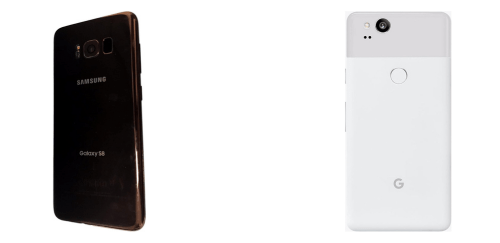
Why Do I Recommend The Samsung Galaxy S8?
- The Samsung Galaxy S8 features a 2960×1440 QHD+ Super AMOLED display for sharper text, finer image detail, and a more immersive viewing experience, while the Google Pixel 2 uses a 1920×1080 Full HD AMOLED display.
- Samsung Galaxy S8 comes with a curved 18.5:9 Infinity Display for improved edge-to-edge content viewing and better multitasking space, whereas the Google Pixel 2 uses a flat 16:9 display.
- It supports microSD card expansion to increase storage capacity for photos, videos, and apps, while the Google Pixel 2 uses fixed internal storage with no expansion support.
- The Samsung Galaxy S8 includes a 3.5mm headphone jack for direct compatibility with wired headphones and audio accessories, while the Google Pixel 2 removes the headphone jack and relies on USB-C or wireless audio.
- Samsung Galaxy S8 supports wireless charging for more convenient cable-free charging at home or in the office, whereas the Google Pixel 2 supports wired charging only.
- It features an iris scanner for an additional secure biometric unlocking method in low-light or gloved conditions, while the Google Pixel 2 uses only a fingerprint sensor.
- The Samsung Galaxy S8 comes with a larger 3000 mAh battery for longer screen-on time during media consumption and daily tasks, while the Google Pixel 2 uses a smaller 2700 mAh battery.
- Samsung Galaxy S8 includes IP68 water and dust resistance for better protection during submersion and harsh environments, whereas the Google Pixel 2 uses a lower IP67 water resistance rating.
Maybe the Google Pixel 2 price can make you comfortable because it’s a little bit cheaper than the Samsung Galaxy S8. But you have to compromise all the above-mentioned features. Now the Decision is Yours. I hope it was helpful to choose the right one.
Side By Side Comparison
| Feature | Samsung Galaxy S8 | Google Pixel 2 |
| Display Size | 5.8″ | 5.0″ |
| Display Resolution | 2960×1440 | 1920×1080 |
| Aspect Ratio | 18.5:9 | 16:9 |
| Display Curvature | Curved | Flat |
| Display PPI | ~570 | ~441 |
| HDR Support | Yes | No |
| Water Resistance | IP68 | IP67 |
| Build Material | Glass back | Aluminum back |
| Headphone Jack | Yes | No |
| microSD Slot | Yes | No |
| Wireless Charging | Yes | No |
| Iris Scanner | Yes | No |
| Face Recognition | Yes | No |
| Front Camera AF | Yes | No |
| Processor Variant | Exynos/Snapdragon | Snapdragon only |
| Audio Tuning | Standard | Front stereo |
| Battery Capacity | 3000 mAh | 2700 mAh |
| Price | Check Samsung S8 Price | Check Pixel 2 Price |
What Common Both Can Do?
- Chipset Family: Both models are powered by the Snapdragon 835 platform, which was Qualcomm’s flagship processor at launch. This ensures comparable processing efficiency and overall system responsiveness.
- CPU Architecture: Each phone uses an octa-core CPU configuration, balancing high-performance cores with efficiency cores. This helps manage demanding tasks while maintaining reasonable power consumption.
- GPU: The Adreno 540 GPU is shared by both devices, enabling similar graphics performance in games and multimedia applications. Users can expect comparable visual smoothness and rendering capabilities.
- RAM: With 4 GB of RAM on both phones, multitasking performance is largely similar. This allows multiple apps to stay active in memory without frequent reloads.
- Internal Storage Type: Both devices use UFS storage, which provides faster read and write speeds than older eMMC solutions. This improves app loading times and overall system fluidity.
- Rear Camera: Each phone features a 12 MP rear camera sensor, placing them in the same resolution class. This ensures comparable base image detail before software processing is applied.
- Optical Image Stabilization: OIS is present on both devices, helping to reduce blur caused by hand movement. This improves photo sharpness and video stability, especially in low-light conditions.
- Phase Detection Autofocus: Both cameras use PDAF technology for faster and more accurate focusing. This is especially useful for capturing moving subjects or spontaneous shots.
- Front Camera: An 8 MP front-facing camera is used on both phones, offering similar resolution for selfies and video calls. This keeps front camera image clarity within the same range.
- Video Recording: Each device supports 4K video recording at 30 frames per second. This allows users to capture high-resolution videos suitable for large displays and editing.
- USB Port: USB Type-C is standard on both models, enabling reversible cable use and faster data transfer. It also supports modern charging accessories.
- Fingerprint Sensor: Both phones include a rear-mounted fingerprint reader for biometric security. This provides quick and reliable device unlocking.
- NFC Support: NFC is available on both devices, enabling contactless payments and quick pairing with compatible accessories. This is essential for modern mobile payment systems.
- Fast Charging: Each smartphone supports fast charging technology, reducing the time needed to recharge the battery. This is especially valuable for users with heavy daily usage.
- Bluetooth Version: Bluetooth 5.0 is present on both phones, improving connection stability and range. It also supports better audio and accessory connectivity.
- Wi-Fi Standard: Both support 802.11ac Wi-Fi, allowing faster wireless internet speeds on compatible networks. This improves streaming and download performance.
- GPS Support: Full GPS support is available on both models, ensuring accurate navigation and location tracking. This is critical for maps and location-based apps.
- Accelerometer: Each phone includes an accelerometer for motion detection. This enables features like screen rotation and fitness tracking.
- Gyroscope: A built-in gyroscope is shared by both devices, enhancing motion sensing accuracy. This improves gaming, navigation, and augmented reality experiences.
Common Features
| Feature | Samsung Galaxy S8 | Google Pixel 2 |
| Chipset Family | Snapdragon 835 | Snapdragon 835 |
| CPU Architecture | Octa-core | Octa-core |
| GPU | Adreno 540 | Adreno 540 |
| RAM | 4 GB | 4 GB |
| Internal Storage Type | UFS | UFS |
| Rear Camera | 12 MP | 12 MP |
| Optical Image Stabilization | Yes | Yes |
| Phase Detection Autofocus | Yes | Yes |
| Front Camera | 8 MP | 8 MP |
| Video Recording | 4K@30fps | 4K@30fps |
| USB Port | USB Type-C | USB Type-C |
| Fingerprint Sensor | Yes | Yes |
| NFC Support | Yes | Yes |
| Fast Charging | Yes | Yes |
| Bluetooth Version | Bluetooth 5.0 | Bluetooth 5.0 |
| Wi-Fi Standard | 802.11ac | 802.11ac |
| GPS Support | Yes | Yes |
| Accelerometer | Yes | Yes |
| Gyroscope | Yes | Yes |
| Price | Check Samsung S8 Price | Check Pixel 2 Price |
FAQ
| Which phone has the better display quality? Samsung Galaxy S8 has a higher-resolution QHD+ Super AMOLED display with a curved design, while Google Pixel 2 uses a smaller Full HD AMOLED panel. The Galaxy S8 screen is sharper and more immersive, especially for media consumption. Which device offers better camera performance overall? Do both phones support optical image stabilization? Which phone has better video stabilization? Is there a headphone jack on both phones? Which phone supports expandable storage? Do both phones support wireless charging? Which phone has better audio output? Are both phones water resistant? Which phone receives software updates for a longer time? Do both phones use the same processor? Which phone has better biometric options? Are both phones suitable for gaming? Which phone is more compact and easier to use one-handed? Which phone is better for a clean Android experience? |