Sony a7 IV & Canon EOS R6 Mark II share many similarities, but there are also important differences, such as quality, performance, features, design, and connectivity. If you want the best one between them, I Would recommend the Sony a7 IV rather than the Canon EOS R6 Mark II.
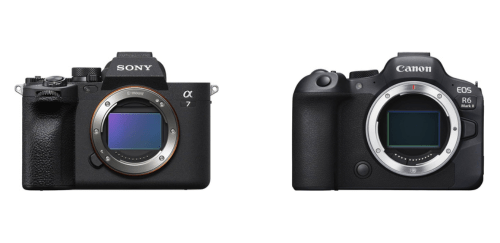
Why Do I Recommend The Sony a7 IV?
- The Sony a7 IV has a 33-megapixel full-frame sensor for higher image detail and greater cropping flexibility in landscape and studio work, while the Canon R6 Mark II uses a 24.2-megapixel full-frame sensor.
- Sony a7 IV features CFexpress Type A card support for faster sustained write speeds and improved reliability during high-bitrate video or long RAW bursts, whereas the Canon R6 Mark II uses SD UHS-II cards only.
- It comes with a full-size HDMI Type A port for more secure connections to external monitors and recorders during professional video production, whereas the Canon R6 Mark II uses a micro HDMI port.
- The Sony a7 IV includes in-body focus breathing compensation for maintaining consistent framing during focus pulls in video recording, while the Canon R6 Mark II lacks a comparable in-camera breathing correction feature.
- Sony a7 IV has a higher flash sync speed of 1/250s for better control of ambient light when using studio strobes or off-camera flash, whereas the Canon R6 Mark II is limited to a 1/200s sync speed.
- It supports All-Intra internal video codecs for easier editing and more predictable frame-by-frame compression in post-production workflows, whereas the Canon R6 Mark II relies on Long GOP compression formats.
- The Sony a7 IV includes a built-in PC sync terminal for direct and reliable integration with professional studio lighting systems, whereas the Canon R6 Mark II does not include a PC sync port.
- Sony a7 IV has higher EVF magnification at 0.78× for a larger and more immersive view when composing images and manually focusing, while the Canon R6 Mark II uses a 0.76× EVF magnification.
Maybe the Canon EOS R6 Mark II can make you comfortable because it’s a little bit cheaper than the Sony a7 IV. But you have to compromise all the above-mentioned features. Now the Decision is Yours. I hope it was helpful to choose the right one.
Side-by-Side Comparison
| Feature | Sony a7 IV | Canon EOS R6 Mark II |
| Sensor resolution | 33 MP | 24.2 MP |
| Max image size | 7008×4672 | 6000×4000 |
| Flash sync | 1/250 s | 1/200 s |
| AF system | Phase-detect + contrast | Dual Pixel CMOS AF II |
| EVF magnification | 0.78× | 0.76× |
| Slot 1 | CFexpress Type A / SD UHS-II | SD UHS-II |
| HDMI port | Full-size Type A | Micro Type D |
| PC sync terminal | Yes | No |
| 4K 30p sampling | 7K oversample | 6K oversample |
| Internal codec | XAVC S / XAVC HS / XAVC S-I | H.264 / H.265 |
| Max internal bitrate | Higher class | Lower class |
| External RAW | 16-bit output | 6K RAW output |
| Price | Check Sony a7 IV Price | Check Canon R6 Mark II Price |
What Common Both Can Do?
- Camera type: Both models are full-frame mirrorless cameras designed for advanced enthusiasts and professionals. This format allows for high image quality while keeping bodies smaller than traditional DSLRs.
- Sensor size: Each camera uses a 35mm full-frame sensor, which delivers strong low-light performance and shallow depth-of-field control. This matters for portrait, event, and cinematic-style shooting.
- Lens mount: Both systems use interchangeable lenses, giving access to extensive native and third-party lens ecosystems. This flexibility allows photographers and videographers to tailor setups to specific shooting needs.
- In-body image stabilization: Each camera includes sensor-shift stabilization to reduce blur from hand movement. This is especially useful for handheld photography and video in low-light conditions.
- Autofocus with eye detection: Both cameras support eye-detection autofocus for people. This improves hit rates for portraits and ensures consistent focus on the subject’s eyes.
- Face detection AF: Face detection is built into both systems to prioritize human subjects automatically. This is valuable for events, interviews, and casual shooting where speed matters.
- Animal detection AF: Both cameras can recognize animals for autofocus tracking. This helps wildlife and pet photographers maintain sharp focus on unpredictable subjects.
- Electronic viewfinder: Each model uses an electronic viewfinder rather than an optical one. EVFs provide real-time exposure preview and shooting information before the image is captured.
- EVF resolution class: Both cameras use a similar high-resolution EVF class around 3.69M dots. This results in clear composition and accurate manual focusing.
- Vari-angle rear LCD: Fully articulating rear screens are present on both bodies. This design supports shooting from high, low, or front-facing angles for video and vlogging.
- Touchscreen control: Touch input is available on both cameras for focus selection and menu navigation. This speeds up operation and improves usability in dynamic shooting scenarios.
- Dual card slots: Each camera includes two memory card slots. This allows for backup recording or separation of photo and video files for safer workflows.
- UHS-II SD support: Both models support fast UHS-II SD cards. Faster cards reduce buffer clearing times and support high-bitrate video recording.
- 4K video recording: Both cameras can record 4K video internally. This meets modern resolution standards for professional and enthusiast video production.
- 10-bit internal video: Each camera supports 10-bit internal recording. This provides greater color depth and flexibility during color grading.
- Log gamma profiles: Log profiles are included on both models for video. These profiles preserve dynamic range and are important for professional post-production workflows.
- Microphone input: Both bodies include a dedicated microphone jack. This enables higher-quality audio capture using external microphones.
- Headphone output: Headphone monitoring is available on both cameras. This allows real-time audio checking during video recording.
- USB-C connectivity: Each camera uses USB-C for data transfer and power-related functions. This improves compatibility with modern accessories and power solutions.
- Weather sealing: Both cameras feature weather-resistant construction. This helps protect the camera during outdoor and travel shooting in challenging conditions.
Common Features
| Feature | Sony a7 IV | Canon EOS R6 Mark II |
| Camera type | Full-frame mirrorless | Full-frame mirrorless |
| Sensor size | 35mm full-frame | 35mm full-frame |
| Lens mount | Interchangeable lens | Interchangeable lens |
| In-body image stabilization | Yes | Yes |
| Autofocus with eye detection | Yes | Yes |
| Face detection AF | Yes | Yes |
| Animal detection AF | Yes | Yes |
| Electronic viewfinder | Yes | Yes |
| EVF resolution class | ~3.69M dots | ~3.69M dots |
| Vari-angle rear LCD | Yes | Yes |
| Touchscreen control | Yes | Yes |
| Dual card slots | Yes | Yes |
| UHS-II SD support | Yes | Yes |
| 4K video recording | Yes | Yes |
| 10-bit internal video | Yes | Yes |
| Log gamma profiles | Yes | Yes |
| Microphone input | Yes | Yes |
| Headphone output | Yes | Yes |
| USB-C connectivity | Yes | Yes |
| Weather sealing | Yes | Yes |
| Price | Check Sony a7 IV Price | Check Canon R6 Mark II Price |
FAQ
Is the Sony a7 IV better for high-resolution photography than the Canon R6 Mark II? Which camera is better for sports and action photography? Do both cameras support in-body image stabilization? Can both cameras record professional-quality video internally? Is there a difference in 4K 60p video recording between the two cameras? Which camera offers better slow-motion video? Do both cameras have advanced autofocus systems? Are both cameras suitable for vlogging and self-recording? What memory card options do the cameras support? Do both cameras have dual card slots for backup recording? Is battery life similar between the two cameras? Are both cameras weather-sealed for outdoor shooting? Do both cameras support external microphones and headphones? Can both cameras be used with a wide range of lenses? Which camera is more balanced for hybrid photo and video use? |