Beosound A1 3rd Gen & JBL Charge 5 share many similarities, but there are also important differences, such as quality, performance, features, design, and connectivity. If you want the best one between them, I Would recommend the Beosound A1 3rd Gen rather than the JBL Charge 5.
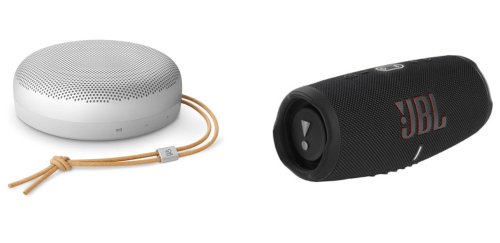
Why Do I Recommend The Beosound A1?
- The Beosound A1 3rd Gen features 360-degree omnidirectional sound for consistent audio coverage in all directions without needing repositioning, while the JBL Charge 5 uses front-facing directional sound.
- Beosound A1 3rd Gen supports aptX Adaptive and AAC codecs for higher-quality wireless audio streaming with lower latency and improved detail, whereas the JBL Charge 5 supports only SBC codec.
- It comes with 3-microphone array for clear voice pickup during calls and virtual meetings in different environments, while the JBL Charge 5 has no microphone.
- The Beosound A1 3rd Gen supports speakerphone functionality for hands-free calling directly from the speaker without using a phone, whereas the JBL Charge 5 does not support call functionality.
- Beosound A1 3rd Gen includes USB-C audio input support for direct wired playback from compatible devices without relying on Bluetooth compression, while the JBL Charge 5 supports USB-C charging only.
- It features a 2-way speaker system with a dedicated tweeter and woofer for improved separation of highs and lows during music playback, whereas the JBL Charge 5 uses a single racetrack driver with passive radiators.
- The Beosound A1 3rd Gen offers 24-hour battery life for longer continuous playback during extended use, while the JBL Charge 5 provides up to 20 hours.
- Beosound A1 3rd Gen features a compact 576 g weight for easier portability and reduced carrying strain during travel, while the JBL Charge 5 weighs is around 960 g.
Maybe the JBL Charge 5 can make you comfortable because it’s a little bit cheaper than the Beosound A1 3rd Gen. But you have to compromise all the above-mentioned features. Now the Decision is Yours. I hope it was helpful to choose the right one.
Side-by-Side Comparison
| Feature | Beosound A1 | JBL Charge 5 |
| Total Output Power | 60 W | 40 W RMS |
| Driver Configuration | 1 × 3.25″ woofer + 1 × 0.6″ tweeter | 1 × racetrack driver + 2 × passive radiators |
| Frequency Range | 54 Hz – 20,000 Hz | 60 Hz – 20,000 Hz |
| Maximum SPL | 92 dB @ 1 m | ~90 dB |
| Bass SPL | 64 dB | Not specified |
| Audio Dispersion | 360° | Front-facing |
| Bluetooth Codecs | SBC, AAC, aptX Adaptive | SBC |
| Multipoint Connection | Yes | No |
| Microphones | 3 microphones | None |
| Speakerphone | Yes | No |
| Battery Life | 24 hours | 20 hours |
| USB-C Audio Input | Yes | No |
| Materials | Aluminum + leather | Fabric + rubber |
| Sustainability Certification | Cradle to Cradle Bronze | None |
| Replaceable Battery | Service-replaceable | Not replaceable |
| App EQ Control | Advanced parametric EQ | Basic EQ |
| Stereo Pairing Tech | True Wireless Stereo | PartyBoost multi-speaker |
| Carrying Method | Integrated leather strap | No strap |
| Sound Channels | 2.0 | Mono |
| Woofer Size | 3.25 inch | Not specified |
| Price | Check Beosound A1 3rd Gen Price | Check JBL Charge 5 Price |
What Common Both Can Do?
- Bluetooth Connectivity: Both speakers use Bluetooth 5.1, ensuring stable wireless connections and efficient power usage during playback. This allows users to stream audio reliably from smartphones, tablets, and laptops without frequent dropouts.
- Wireless Audio Streaming: Both devices support wireless music playback, enabling users to stream audio directly from compatible devices. This removes the need for cables and simplifies everyday usage.
- Portable Design: Each speaker is designed for portability, making it easy to carry for travel, outdoor activities, or room-to-room use. Their compact builds allow convenient placement in different environments.
- Built-in Battery: Both models include integrated batteries, allowing them to operate without being plugged into a power source. This ensures flexibility for both indoor and outdoor listening.
- Rechargeable via USB-C: Both speakers use USB-C charging, providing faster and more efficient charging compared to older standards. This also ensures compatibility with modern charging cables and adapters.
- Waterproof Rating: Both devices carry an IP67 rating, meaning they are protected against water immersion and splashes. This makes them suitable for use near pools, beaches, or in rainy conditions.
- Dustproof Protection: Each speaker is resistant to dust ingress, which helps maintain long-term performance in outdoor or dusty environments. This is particularly useful for travel and outdoor adventures.
- App Support: Both speakers connect to companion mobile apps that allow users to control settings and features. This enhances customization and provides firmware updates for improved performance.
- Equalizer Adjustment: Both devices include EQ controls through their apps, enabling users to adjust sound profiles based on preferences. This helps tailor audio output for different music genres or environments.
- Multi-Speaker Pairing: Each speaker supports pairing with additional units, allowing users to expand sound coverage across larger areas. This is useful for parties or multi-room setups.
- Stereo Pairing (Same Model): Both models can pair with another identical unit to create a stereo sound setup. This improves channel separation and enhances the listening experience.
- Passive Bass Enhancement: Both speakers incorporate passive bass mechanisms to enhance low-frequency output. This allows for deeper bass without requiring significantly larger drivers.
- Outdoor Usage Support: Both devices are designed for outdoor environments, combining durability and portability. This ensures reliable performance during travel, camping, or outdoor gatherings.
- Lithium-ion Battery: Each speaker uses a lithium-ion battery, which provides efficient energy storage and consistent performance over multiple charge cycles. This contributes to long-term usability.
- Wireless Range (~10 m): Both speakers support a typical Bluetooth range of around 10 meters, allowing users to move freely without losing connection. This provides flexibility in everyday usage.
- Firmware Updates via App: Both models receive firmware updates through their respective apps, enabling performance improvements and feature enhancements over time. This keeps the devices up to date.
- LED Indicator: Each speaker includes LED indicators to display power status, charging state, and connectivity. This provides quick visual feedback for users.
- Single USB-C Port: Both devices rely on a USB-C port for charging, simplifying connectivity and reducing the need for multiple cable types.
Common Features
| Feature | Beosound A1 3rd Gen | JBL Charge 5 |
| Bluetooth Connectivity | Yes | Yes |
| Wireless Audio Streaming | Yes | Yes |
| Portable Design | Yes | Yes |
| Built-in Battery | Yes | Yes |
| Rechargeable via USB-C | Yes | Yes |
| Waterproof Rating | Yes | Yes |
| Dustproof Protection | Yes | Yes |
| App Support | Yes | Yes |
| Equalizer Adjustment | Yes | Yes |
| Multi-Speaker Pairing | Yes | Yes |
| Stereo Pairing (Same Model) | Yes | Yes |
| Passive Bass Enhancement | Yes | Yes |
| Outdoor Usage Support | Yes | Yes |
| Lithium-ion Battery | Yes | Yes |
| Wireless Range (~10 m) | Yes | Yes |
| Firmware Updates via App | Yes | Yes |
| LED Indicator | Yes | Yes |
| Single USB-C Port | Yes | Yes |
| Price | Check Beosound A1 3rd Gen Price | Check JBL Charge 5 Price |
FAQ
Which speaker is louder between Beosound A1 3rd Gen and JBL Charge 5? Does Beosound A1 3rd Gen have better sound quality than JBL Charge 5? Which speaker has better bass performance? Is Beosound A1 3rd Gen more portable than JBL Charge 5? Do both speakers support waterproofing? Can both speakers be used for phone calls? Which speaker has longer battery life? Does JBL Charge 5 support charging other devices? Do both speakers support stereo pairing? Which speaker supports better Bluetooth audio codecs? Are both speakers compatible with mobile apps? Which speaker is better for outdoor use? Do both speakers support wired audio input? Which speaker uses more premium materials? |