ASUS RT-AC88U & ASUS RT-AC3100 share many similarities, but there are also important differences, such as quality, performance, features, design, and connectivity. If you want the best one between them, I Would recommend the ASUS RT-AC88U rather than the ASUS RT-AC3100.
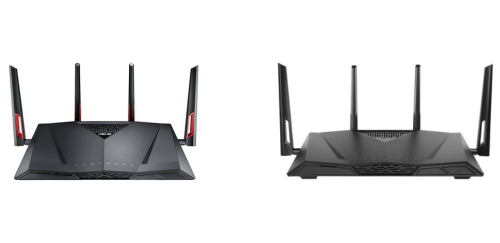
Why Do I Recommend The ASUS RT-AC88U?
- The ASUS RT-AC88U comes with eight Gigabit LAN ports to connect multiple PCs, consoles, smart TVs, and NAS devices directly without an external switch, while the ASUS RT-AC3100 has four Gigabit LAN ports.
- ASUS RT-AC88U features a built-in eight-port Gigabit switch for simplifying wired network expansion in home offices and small studios, whereas the ASUS RT-AC3100 uses a standard four-port switch.
- It supports denser wired device layouts to reduce network complexity and cable routing through extra hardware, while the ASUS RT-AC3100 uses fewer LAN connections.
- The ASUS RT-AC88U includes more LAN status LEDs to provide clearer real-time visibility of individual wired device activity and troubleshooting, while the ASUS RT-AC3100 includes fewer LAN indicators.
- ASUS RT-AC88U comes with greater direct NAS and media server connectivity to maintain full Gigabit speeds without daisy-chained switches, whereas the ASUS RT-AC3100 has limited direct wired capacity.
- It features improved wired scalability for gaming setups with multiple consoles and PCs connected simultaneously, while the ASUS RT-AC3100 reaches its port limit faster.
- The ASUS RT-AC88U supports simpler wired network topology to minimize latency introduced by additional switching hardware, while the ASUS RT-AC3100 often relies on an external switch.
- ASUS RT-AC88U comes with stronger all-in-one router-and-switch capability for small offices and advanced home networks, whereas the ASUS RT-AC3100 focuses primarily on wireless performance with fewer wired connections.
Maybe the ASUS RT-AC3100 can make you comfortable because it’s a little bit cheaper than the ASUS RT-AC88U. But you have to compromise all the above-mentioned features. Now the Decision is Yours. I hope it was helpful to choose the right one.
Side-by-Side Comparison
| Feature | ASUS RT-AC88U | ASUS RT-AC3100 |
| LAN Ports | 8 × Gigabit LAN | 4 × Gigabit LAN |
| Total Ethernet Ports | 9 | 5 |
| Antennas | 4 External Detachable | 4 External |
| Height | ~60 mm | ~83.8 mm |
| Width | ~300 mm | ~299.7 mm |
| Depth | ~190 mm | ~187.9 mm |
| Switch Type | Integrated 8-Port Switch | Standard 4-Port Switch |
| Maximum Devices | Higher Wired Device Count | Lower Wired Device Count |
| LED Indicators | More | Fewer |
| Price | Check ASUS RT-AC88U Price | Check ASUS RT-AC3100 Price |
What Common Both Can Do?
- Wi-Fi Standard: Both routers use the Wi-Fi 5 (802.11ac) standard, ensuring compatibility with a wide range of modern wireless devices. This allows stable high-speed connections for laptops, smartphones, and smart home products.
- Wi-Fi Class: Each model is rated AC3100, indicating a combined theoretical throughput across both bands. This class positioning places both routers in the high-performance consumer segment.
- Dual-Band Support: Both units operate on 2.4 GHz and 5 GHz bands simultaneously. This helps balance device loads and reduce congestion in mixed-device environments.
- 2.4 GHz Band: The shared 2.4 GHz band provides longer range and better wall penetration. It is useful for older devices and smart home accessories.
- 5 GHz Band: Both support 5 GHz connectivity for higher speeds and lower latency. This is important for gaming, streaming, and large file transfers.
- Maximum Wi-Fi Speed: Each router supports up to 3100 Mbps combined wireless speed. This allows them to handle multiple high-bandwidth tasks at the same time.
- MU-MIMO: Both models include MU-MIMO technology, enabling simultaneous data transmission to multiple devices. This improves efficiency in homes with many connected clients.
- Beamforming: Beamforming is present on both routers to focus signal strength toward connected devices. This helps improve signal stability and coverage consistency.
- CPU Architecture: Each router uses a dual-core processor, providing sufficient processing power for routing, security, and advanced features. This supports stable performance under load.
- CPU Clock Speed: Both operate at 1.4 GHz, ensuring similar raw processing capability. This matters for tasks like QoS, VPN, and traffic management.
- RAM: With 512 MB of RAM on both models, multitasking and simultaneous connections are handled smoothly. This is especially relevant for busy networks.
- Flash Storage: Each router includes 128 MB of flash storage for firmware and feature support. This allows room for updates and advanced ASUS firmware functions.
- USB Ports: Both routers include one USB 3.0 and one USB 2.0 port. These can be used for network storage, printers, or media sharing.
- AiMesh Support: Both models support AiMesh, allowing them to be used as part of a mesh network. This enables seamless whole-home coverage with compatible ASUS routers.
- Adaptive QoS: Each router includes Adaptive QoS for traffic prioritization. This helps maintain performance for gaming, streaming, and work applications.
- VPN Server/Client: Both support VPN server and client modes. This allows secure remote access and encrypted internet connections.
- Guest Network: Guest network functionality is available on both routers. This helps isolate visitor devices from the main network.
- Parental Controls: Both include parental control features for managing access and usage. This is useful for family and shared environments.
- IPv6 Support: Each router supports IPv6 networking. This ensures long-term compatibility with modern internet infrastructure.
- Firewall Protection: Both include built-in firewall and security protections. This helps safeguard the network from unauthorized access and threats.
Common Features
| Feature | ASUS RT-AC88U | ASUS RT-AC3100 |
| Wi-Fi Standard | Wi-Fi 5 | Wi-Fi 5 |
| Wi-Fi Class | AC3100 | AC3100 |
| Dual-Band Support | Yes | Yes |
| 2.4 GHz Band | Yes | Yes |
| 5 GHz Band | Yes | Yes |
| Maximum Wi-Fi Speed | Up to 3100 Mbps | Up to 3100 Mbps |
| MU-MIMO | Yes | Yes |
| Beamforming | Yes | Yes |
| CPU Architecture | Dual-core | Dual-core |
| CPU Clock Speed | 1.4 GHz | 1.4 GHz |
| RAM | 512 MB | 512 MB |
| Flash Storage | 128 MB | 128 MB |
| USB Ports | 2 | 2 |
| AiMesh Support | Yes | Yes |
| Adaptive QoS | Yes | Yes |
| VPN Server/Client | Yes | Yes |
| Guest Network | Yes | Yes |
| Parental Controls | Yes | Yes |
| IPv6 Support | Yes | Yes |
| Firewall Protection | Yes | Yes |
| Price | Check ASUS RT-AC88U Price | Check ASUS RT-AC3100 Price |
FAQ
Are the RT-AC88U and RT-AC3100 built on the same Wi-Fi standard? Do both routers support dual-band wireless connectivity? Is the maximum wireless speed the same on both models? Do both routers support MU-MIMO technology? Is beamforming available on both routers? Do the RT-AC88U and RT-AC3100 use the same processor? Is the system memory identical between the two routers? Do both routers have the same internal storage capacity? Are USB ports included on both models? Do both routers support ASUS AiMesh? Is Adaptive QoS available on both routers? Can both routers be used as VPN servers or clients? Do both routers offer guest network functionality? Is IPv6 supported on both routers? Do both routers include built-in security and firewall features? |