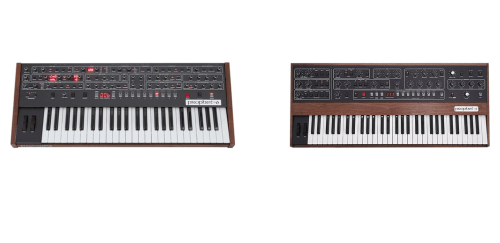
Prophet-6 & Prophet-5 share many similarities, but there are also important differences, such as quality, performance, features, design, and connectivity. If you want the best one between them, I Would recommend the Prophet-6 rather than the Prophet-5.
Why Do I Recommend The Prophet-6?
- The Prophet 6 features 6 voices for playing fuller chords and sustaining more notes without voice stealing, while the Prophet 5 has 5 voices.
- Prophet 6 includes built-in digital effects for adding reverb, delay, and modulation directly within the instrument during performance and recording, whereas the Prophet 5 has no onboard effects.
- It comes with a sub oscillator to reinforce bass frequencies and add extra low-end weight to sounds, while the Prophet 5 uses only two main oscillators per voice.
- The Prophet 6 supports a built-in polyphonic step sequencer for creating evolving patterns and rhythmic sequences without external gear, while the Prophet 5 has no sequencer.
- Prophet 6 has a high-pass filter for shaping low-frequency content and tightening layered patches in mixes, whereas the Prophet 5 does not include a high-pass filter.
- It supports tempo-synced LFO and arpeggiator functions for keeping modulation and patterns locked to external clocks, while the Prophet 5 does not support tempo sync.
- The Prophet 6 comes with a compact 49-key keyboard for easier transport and space-efficient studio setups, whereas the Prophet 5 uses a larger 61-key keyboard.
- Prophet 6 features a higher preset memory capacity for storing more sounds and recalling setups quickly in live and studio workflows, while the Prophet 5 has fewer preset slots.
Maybe the Prophet-5 can make you comfortable because it’s a little bit cheaper than the Prophet-6. But you have to compromise all the above-mentioned features. Now the Decision is Yours. I hope it was helpful to choose the right one.
Side-by-Side Comparison
| Feature | Prophet-6 | Prophet-5 |
| Voices | 6 | 5 |
| Oscillators per Voice | 2 VCOs + Sub | 2 VCOs |
| Sub Oscillator | Yes | No |
| Effects Engine | Yes | No |
| Effects Types | Reverb, Delay, Chorus, Phaser, Distortion | None |
| Effects Bypass | True analog bypass | Not applicable |
| Filter Revisions | Single modern | Rev 1/2 or Rev 3 |
| High-Pass Filter | Yes | No |
| Poly Mod Destinations | Expanded | Limited |
| LFO Sync | Tempo sync | No sync |
| Arpeggiator Sync | Tempo sync | No sync |
| Sequencer | Polyphonic | None |
| Preset Memory | 500 programs | 200 programs |
| Preset Banks | More banks | Fewer banks |
| Signal Path | Analog + digital FX | Fully analog |
| Tuning Behavior | Stable | Variable |
| Weight | Lighter | Heavier |
| Production Era | Modern | Vintage recreation |
| Price | Check Prophet-6 Price | Check Prophet-5 Price |
What Common Both Can Do?
- Analog Signal Path: Both synthesizers use a fully analog audio path, preserving the classic warmth and harmonic richness associated with vintage instruments. This matters for players seeking authentic analog tone without digital coloration.
- Polyphonic Synth: Each model supports true polyphony, allowing multiple notes to sound simultaneously. This is essential for chords, pads, and complex harmonic performances.
- Voltage-Controlled Oscillators: Both instruments rely on VCOs rather than digitally controlled oscillators. This contributes to organic tuning behavior and a more lively sound character.
- Oscillators per Voice: Prophet 6 and Prophet 5 each provide two oscillators per voice. This enables detuning, interval layering, and thicker timbral construction.
- Oscillator Waveforms: Both synths include sawtooth, pulse, and triangle waveforms. These foundational shapes allow a wide range of classic subtractive synthesis tones.
- Analog Low-Pass Filter: Each model uses a 4-pole low-pass filter design. This filter type is crucial for smooth cutoff sweeps and strong bass retention.
- Filter Envelope: Both synthesizers include a dedicated envelope for filter modulation. This allows dynamic shaping of brightness over time for expressive sounds.
- Amplifier Envelope: Each model features an ADSR envelope controlling amplitude. This gives precise control over attack, decay, sustain, and release characteristics.
- Poly Mod Section: Both include a Poly Mod section for advanced modulation routing. This enables more complex and evolving sound design beyond basic synthesis.
- LFO: Prophet 6 and Prophet 5 each provide a single low-frequency oscillator. The LFO is important for vibrato, tremolo, and cyclic modulation effects.
- Keyboard: Both instruments use semi-weighted keyboards. This balances expressive control with comfortable playability for long sessions.
- Velocity Sensitivity: Each keyboard responds to playing dynamics. This allows volume or timbre changes based on how hard keys are pressed.
- Aftertouch: Both models support aftertouch. This enables real-time modulation by applying pressure after a key is pressed.
- Patch Memory: Prophet 6 and Prophet 5 both allow users to save and recall presets. This is essential for live performance and studio workflow efficiency.
- MIDI Support: Each synth includes MIDI connectivity. This ensures compatibility with modern DAWs, controllers, and external sequencing setups.
- Sustain Pedal Input: Both models support a sustain pedal connection. This allows traditional piano-style note holding during performance.
- Pitch Bend Wheel: Each instrument includes a pitch bend wheel. This provides expressive pitch modulation for solos and performance nuance.
- Modulation Wheel: Both feature a modulation wheel for real-time control. This allows performers to shape vibrato, filter movement, or other assigned parameters on the fly.
Common Features
| Feature | Prophet-6 | Prophet-5 |
| Analog Signal Path | Fully analog | Fully analog |
| Polyphonic Synth | Yes | Yes |
| Voltage-Controlled Oscillators | VCOs | VCOs |
| Oscillators per Voice | 2 | 2 |
| Oscillator Waveforms | Saw, Pulse, Triangle | Saw, Pulse, Triangle |
| Analog Low-Pass Filter | 4-pole | 4-pole |
| Filter Envelope | Yes | Yes |
| Amplifier Envelope | Yes | Yes |
| Poly Mod Section | Yes | Yes |
| LFO | Single | Single |
| Keyboard | Semi-weighted | Semi-weighted |
| Velocity Sensitivity | Yes | Yes |
| Aftertouch | Yes | Yes |
| Patch Memory | Yes | Yes |
| MIDI Support | Yes | Yes |
| Sustain Pedal Input | Yes | Yes |
| Pitch Bend Wheel | Yes | Yes |
| Modulation Wheel | Yes | Yes |
| Price | Check Prophet-6 Price | Check Prophet-5 Price |
FAQ
What type of synthesizers are Prophet-6 and Prophet-5? Do Prophet-6 and Prophet-5 use fully analog signal paths? Are the oscillators in Prophet-6 and Prophet-5 analog or digital? How many oscillators per voice do Prophet-6 and Prophet-5 have? Do both synthesizers support polyphonic playing? Do Prophet-6 and Prophet-5 share the same filter type? Do both models include envelope generators? Is there a Poly Mod section on both Prophet-6 and Prophet-5? Do Prophet-6 and Prophet-5 include an LFO? Are the keyboards velocity-sensitive on both synths? Do both synthesizers support aftertouch? Can presets be saved and recalled on both instruments? Do Prophet-6 and Prophet-5 support MIDI connectivity? Are performance controls included on both models? Are Prophet-6 and Prophet-5 suitable for both studio and live use? |