Radeon RX 7900 GRE & Radeon RX 7800 XT share many similarities, but there are also important differences, such as quality, performance, features, design, and connectivity. If you want the best one between them, I Would recommend the Radeon RX 7900 GRE rather than the Radeon RX 7800 XT.
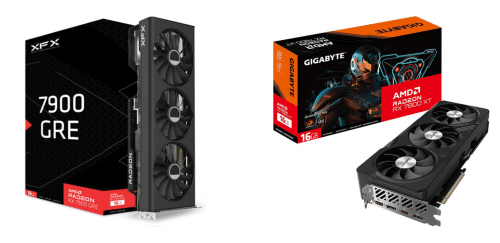
Why Do I Recommend The Radeon RX 7900 GRE?
- The Radeon RX 7900 GRE has 80 compute units for higher parallel processing throughput in demanding games and GPU-heavy workloads, while the Radeon RX 7800 XT has 60 compute units.
- Radeon RX 7900 GRE includes 5,120 stream processors to handle more simultaneous shader operations for improved performance at higher resolutions, whereas the Radeon RX 7800 XT uses 3,840 stream processors.
- It features 80 ray accelerators for stronger ray tracing performance in lighting, reflections, and shadows, while the Radeon RX 7800 XT features 60 ray accelerators.
- The Radeon RX 7900 GRE comes with 160 AI accelerators to better support AI-assisted upscaling and future AI-driven graphics features, while the Radeon RX 7800 XT includes 120 AI accelerators.
- Radeon RX 7900 GRE uses a larger Navi 31 GPU die to enable higher overall compute density and long-term performance scaling, whereas the Radeon RX 7800 XT uses the smaller Navi 32 die.
- It has higher texture unit counts to process more textures per clock for improved visual consistency in complex scenes, while the Radeon RX 7800 XT has fewer texture units.
- The Radeon RX 7900 GRE supports a higher rasterization performance ceiling for compute-heavy and modern game engines, while the Radeon RX 7800 XT relies more on higher clock speeds.
- Radeon RX 7900 GRE comes with a compute-focused design that scales better in productivity and multi-threaded GPU workloads, whereas the Radeon RX 7800 XT is more clock-driven and gaming-centric.
Maybe the Radeon RX 7800 XT price can make you comfortable because it’s a little bit cheaper than the Radeon RX 7900 GRE. But you have to compromise all the above-mentioned features. Now the Decision is Yours. I hope it was helpful to choose the right one.
Side By Side Comparison
| Feature | Radeon RX 7900 GRE | Radeon RX 7800 XT |
| Die Class | Large | Mid-size |
| Compute Units | 80 | 60 |
| Stream Processors | 5,120 | 3,840 |
| Ray Accelerators | 80 | 60 |
| AI Accelerators | 160 | 120 |
| Texture Units | 320 | 240 |
| Render Output Units | 128 | 96 |
| Shader Throughput | Higher | Lower |
| Ray Tracing Throughput | Higher | Lower |
| AI Compute Throughput | Higher | Lower |
| Overclocking Headroom | Higher CU-based | Higher clock-based |
| Raster Performance Ceiling | Higher | Lower |
| Launch Scope | Regional | Global |
| Price | Check RX 7900 GRE Price | Check RX 7800 XT Price |
What Common Both Can Do?
- RDNA 3 Architecture: Both GPUs are built on AMD’s RDNA 3 architecture, which improves efficiency and performance per watt over previous generations. This ensures strong gaming performance and modern feature support across current and upcoming titles.
- Advanced Manufacturing Process: Each card uses a chiplet-based design combining 5 nm and 6 nm nodes. This approach helps balance power efficiency with high compute density.
- PCIe 4.0 x16 Interface: Both GPUs use a full PCIe 4.0 x16 interface, ensuring maximum bandwidth compatibility with modern desktop platforms. This prevents bottlenecks when paired with high-end CPUs.
- 16 GB GDDR6 VRAM: Each model comes equipped with 16 GB of GDDR6 memory. This capacity is ideal for high-resolution gaming, large texture packs, and long-term usability.
- 256-bit Memory Bus: Both cards use a 256-bit memory interface, allowing consistent data flow between the GPU and memory. This helps maintain stable performance in demanding games.
- 64 MB Infinity Cache: AMD includes 64 MB of Infinity Cache on both GPUs to reduce memory latency. This improves efficiency and boosts performance in bandwidth-sensitive workloads.
- Hardware Ray Tracing: Both GPUs feature dedicated ray accelerators for real-time ray tracing. This enables enhanced lighting, reflections, and shadows in supported games.
- AI Accelerators: Each card includes AI acceleration hardware for upscaling and future AI-driven features. This helps support technologies like FSR and upcoming AI workloads.
- DirectX 12 Ultimate Support: Both GPUs fully support DirectX 12 Ultimate. This ensures access to modern rendering features such as mesh shaders and variable rate shading.
- AV1 Encoding and Decoding: Both cards support AV1 video encode and decode. This is valuable for streamers and content creators seeking higher video quality at lower bitrates.
- DisplayPort 2.1 Support: Each GPU includes DisplayPort 2.1 outputs. This allows support for very high refresh rates and resolutions on next-generation monitors.
- HDMI 2.1 Support: Both models feature HDMI 2.1 connectivity. This enables 4K 120Hz and 8K output for modern TVs and gaming displays.
- 8K Resolution Support: Each GPU can drive displays up to 7680 × 4320 resolution. This makes them suitable for ultra-high-resolution setups and professional workflows.
- Multi-Monitor Capability: Both GPUs support multi-display configurations. This is useful for productivity, streaming setups, and immersive gaming environments.
- Smart Access Memory: Both cards support AMD Smart Access Memory when paired with compatible Ryzen CPUs. This allows the CPU full access to GPU memory for improved performance.
- AMD FreeSync Compatibility: Each GPU supports FreeSync technology. This reduces screen tearing and delivers smoother gameplay on compatible monitors.
- Radeon Software Features: Both GPUs support Radeon Super Resolution and Radeon Anti-Lag. These features help improve performance scaling and reduce input latency in games.
Common Features
| Feature | Radeon RX 7900 GRE | Radeon RX 7800 XT |
| GPU Architecture | RDNA 3 | RDNA 3 |
| Manufacturing Process | 5 nm + 6 nm | 5 nm + 6 nm |
| PCIe Interface | PCIe 4.0 x16 | PCIe 4.0 x16 |
| VRAM Capacity | 16 GB | 16 GB |
| Memory Type | GDDR6 | GDDR6 |
| Memory Bus | 256-bit | 256-bit |
| Infinity Cache | 64 MB | 64 MB |
| Ray Tracing Support | Yes | Yes |
| AI Accelerators | Yes | Yes |
| Shader Model | DirectX 12 Ultimate | DirectX 12 Ultimate |
| AV1 Encode | Yes | Yes |
| AV1 Decode | Yes | Yes |
| DisplayPort | 2.1 | 2.1 |
| HDMI | 2.1 | 2.1 |
| Max Resolution | 7680 × 4320 | 7680 × 4320 |
| Multi-Monitor Support | Yes | Yes |
| Smart Access Memory | Yes | Yes |
| FreeSync Support | Yes | Yes |
| Radeon Super Resolution | Yes | Yes |
| Radeon Anti-Lag | Yes | Yes |
| Price | Check RX 7900 GRE Price | Check RX 7800 XT Price |